Slides
The slides shown in the recording: 19 decks, 428 pages. These are frames of the video, not the authors’ original files. Every slide carries a timecode — a link to the exact second of the video.
What these files are
Small text on the slides is limited by the quality of the recording: what cannot be read in the video cannot be read here either. The images are recompressed as JPEG; the PDF of each deck can be downloaded from the deck page. There are 19 decks for 22 items in the program: Zaitsev’s closed-door talk is not in the recording, and no decks were assembled for the opening and the closing.
 Duplicators vs. manual copying: when speed and accuracy are criticalVladimir Greshnov27 pages · 00:08:00
 Dictionary or mask: how MK Brute Force worksValeria Vakhrushina33 pages · 00:28:46
 Specifics of accelerating password brute-forcing on mobile devicesVyacheslav Chikin12 pages · 00:49:14
 A standard methodology for examining information stored on mobile devices and their componentsOlga Tushkanova15 pages · 01:05:11
 Applying forensic methods to investigate thefts committed with NFC technologyAlexey Moskvichev15 pages · 01:41:43
 Using VR-EXPERT to examine DVRs. A comparison with foreign counterpartsSergey Eremin30 pages · 02:21:35
 SpyNote in action: how a mobile spyware trojan is created, deployed and examinedNatalia Kotova23 pages · 03:01:03
 Examining information by dynamic analysis on macOS-based personal computersAndrey Shavlovsky24 pages · 03:31:27
 Identifying the owners, administrators and developers of web resourcesIgor Bederov18 pages · 03:55:15
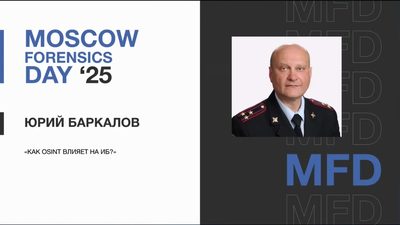 How does OSINT affect information security?Yuri Barkalov14 pages · 04:15:01
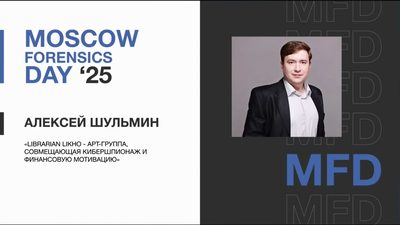 Librarian Likho — an APT group combining cyberespionage and financial motivationAlexey Shulmin21 pages · 04:51:26
 UWP in the DFIR crosshairs: what modern Windows apps are hidingVladislav Azersky22 pages · 05:28:48
 The value of security tools: what we wouldn't have if we had everythingNikita Vyugin32 pages · 05:49:38
 The role of reverse engineering in understanding artifacts: when documentation is the enemy and the decompiler is a friendMaxim Sukhanov24 pages · 06:35:59
 How not to end up needing forensics, and what to do if it can't be avoidedKonstantin Titkov31 pages · 06:59:16
 The role of the user interface in digital investigations: how UI convenience and intuitiveness speed up data analysis and searchNikita Pavlov10 pages · 07:29:52
 Using steganography in various channels to identify the source of a data leakAlexey Drozd13 pages · 07:53:11
 Automated government systems under the forensic computer expert's microscope: problems and solutionsOleg Bezik12 pages · 08:14:16
 From audio and video data to evidence: AI analytics, biometrics, and spoofing and deepfake detectionMikhail Inkin52 pages · 08:51:41