Slides / 15 of 19
Talk slides
How not to end up needing forensics, and what to do if it can't be avoided
Konstantin Titkov · Gazprombank
Day 2 — Friday, 12 September 2025: information security day · Scheduled 14:20–14:50 · In the recording 06:58:14–07:26:12
These slides are an English version of the Russian deck shown in the recording: the text the authors set in the presentation has been translated and redrawn in place, while everything captured from a screen — program windows, logs, evidence — is left exactly as it was, in Russian. The fonts are the closest available ones, not the originals. The Russian deck is on the RU version of this page. Under each slide its text is set out for word search and machine reading.
Page 106:59:16 Slide text
MOSCOW
FORENSICS
DAY '25
MIl
KONSTANTIN TITKOV
“HOW NOT TO END UP NEEDING FORENSICS, AND WHAT TO DO IF IT CAN’T BE AVOIDED”
MFD MFD
Page 206:59:36 Slide text
What to do when everything is encrypted and stolen
Konstantin Titkov
Head of subsidiary cybersecurity centre, Gazprombank
Cyberdom ambassador
09.2025
Page 307:00:12 Slide text
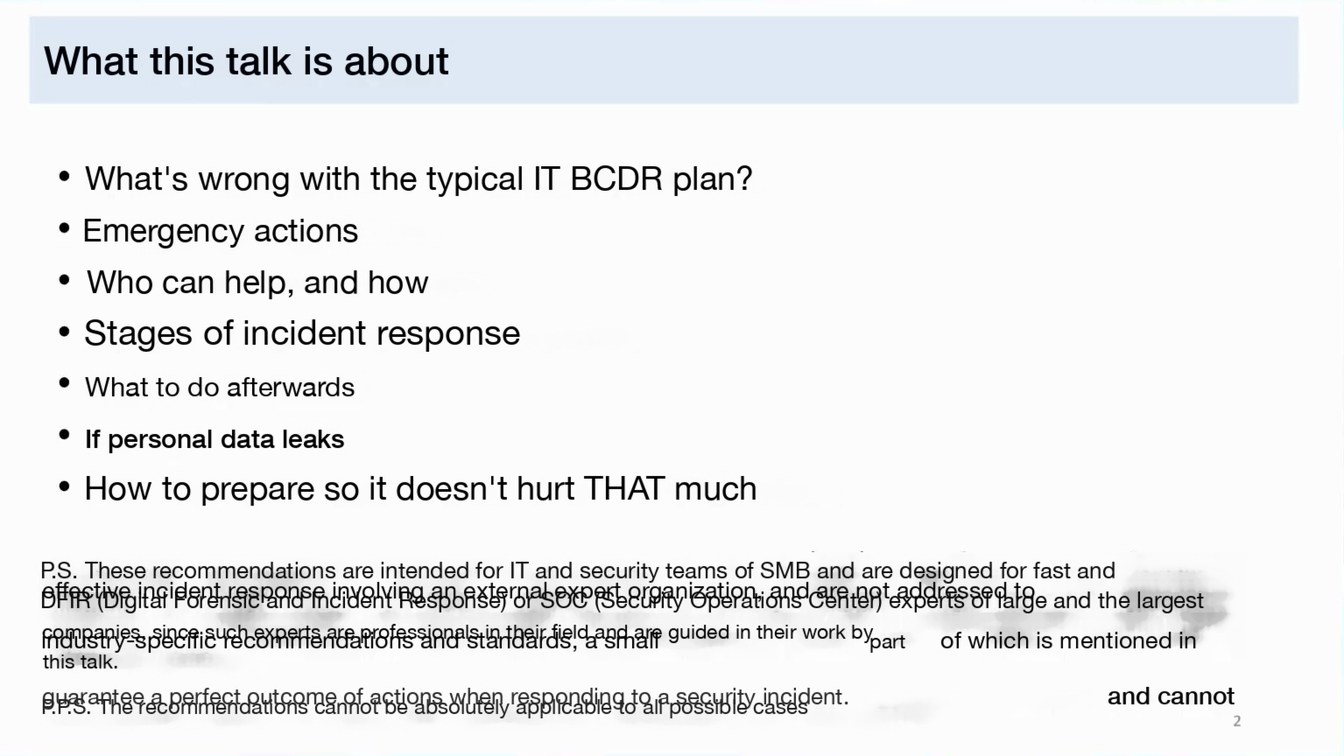
What this talk is about
What's wrong with the typical IT BCDR plan?
Emergency actions
Who can help, and how
Stages of incident response What to do afterwards If personal data leaks How to prepare so it doesn't hurt THAT much
P.S. These recommendations are intended for IT and security teams of SMB and are designed for fast and effective incident response involving an external expert organization, and are not addressed to DFIR (Digital Forensic and Incident Response) or SOC (Security Operations Center) experts of large and the largest companies, since such experts are professionals in their field and are guided in their work by industry-specific recommendations and standards, a small
of which is mentioned in
part
this talk.
P.P.S. The recommendations cannot be absolutely applicable to all possible cases
and cannot
guarantee a perfect outcome of actions when responding to a security incident.
2
Page 407:00:52 Slide text
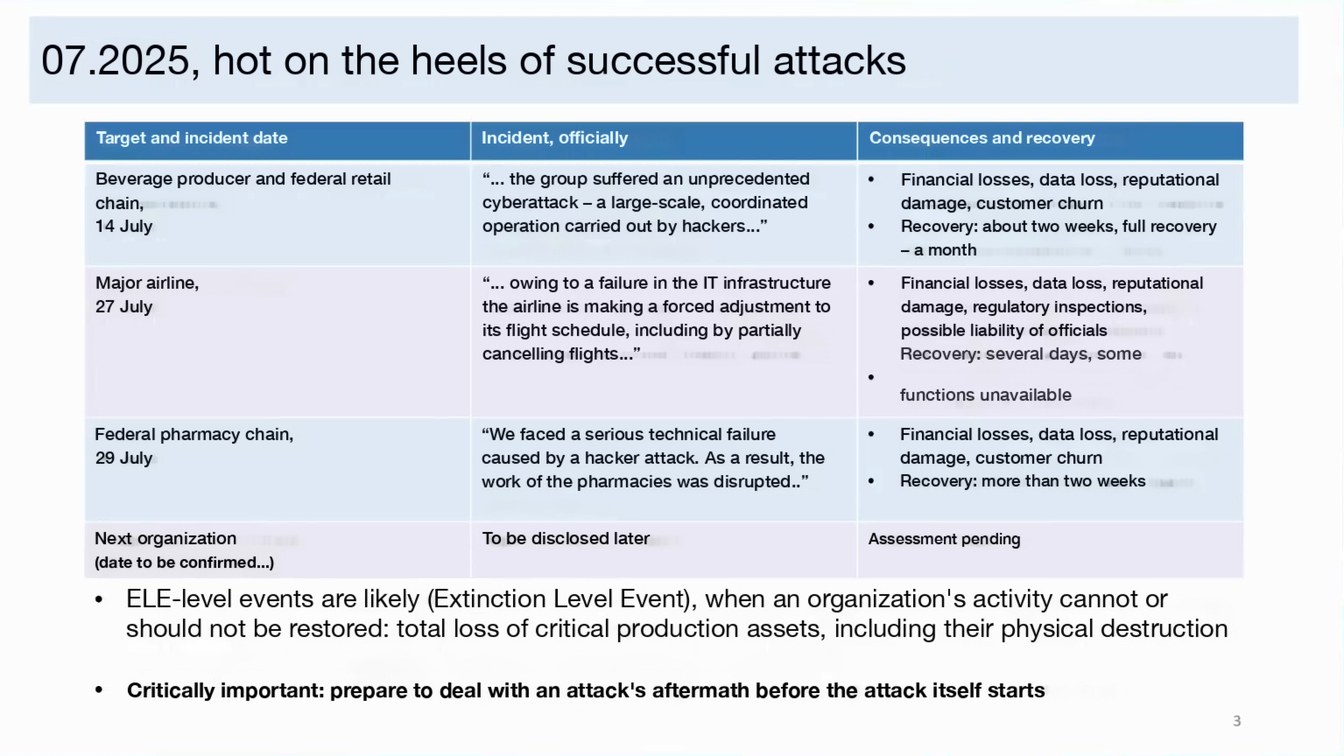
07.2025, hot on the heels of successful attacks
Target and incident date
Incident, officially
Consequences and recovery
Beverage producer and federal retail chain,
14 July
“... the group suffered an unprecedented cyberattack – a large-scale, coordinated operation carried out by hackers...”
Financial losses, data loss, reputational damage, customer churn Recovery: about two weeks, full recovery – a month
Major airline,
27 July
Federal pharmacy chain,
29 July
Financial losses, data loss, reputational damage, regulatory inspections, possible liability of officials
“... owing to a failure in the IT infrastructure the airline is making a forced adjustment to its flight schedule, including by partially cancelling flights...”
Recovery: several days, some functions unavailable Financial losses, data loss, reputational damage, customer churn
“We faced a serious technical failure caused by a hacker attack. As a result, the work of the pharmacies was disrupted..”
Recovery: more than two weeks
Next organization (date to be confirmed...)
To be disclosed later
Assessment pending
ELE-level events are likely (Extinction Level Event), when an organization's activity cannot or should not be restored: total loss of critical production assets, including their physical destruction
Critically important: prepare to deal with an attack's aftermath before the attack itself starts
3
Page 507:01:32 Slide text
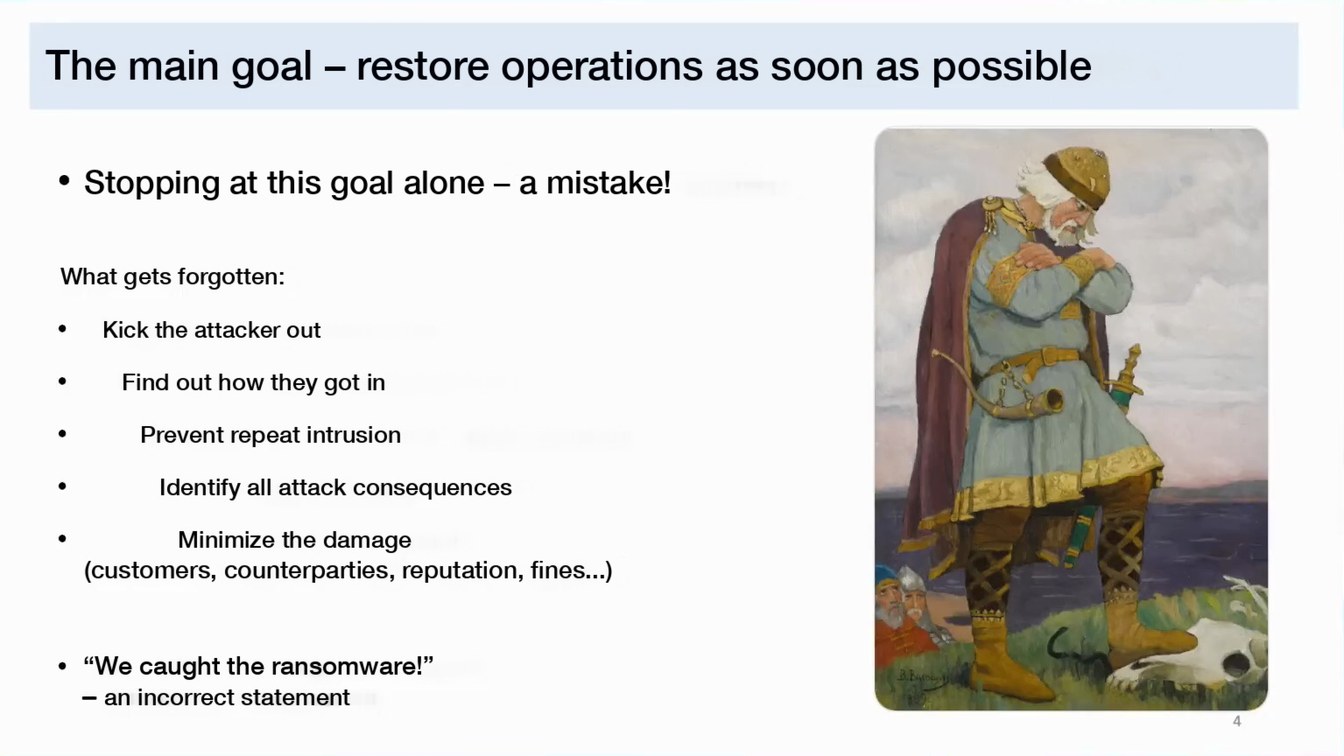
The main goal – restore operations as soon as possible
Stopping at this goal alone – a mistake!
What gets forgotten:
Kick the attacker out
Find out how they got in
Prevent repeat intrusion
Identify all attack consequences
Minimize the damage
(customers, counterparties, reputation, fines...)
“We caught the ransomware!” an incorrect statement
Page 607:03:10 Slide text
There is a plan, but the wrong one
IT incident: human error or technical failure
Recovery in a few hours (recovering data and individual IT infrastructure elements is practised and honed)
Security incident: targeted deliberate malicious action on all or any elements of the infrastructure and the personnel, at any time and adaptively – allowing for counter-actions
Recovery in several days / weeks
Time is spent on: panic / pointless actions making the decision to respond incident response restoring the IT infrastructure
restoring data
5
Page 707:04:41 Slide text
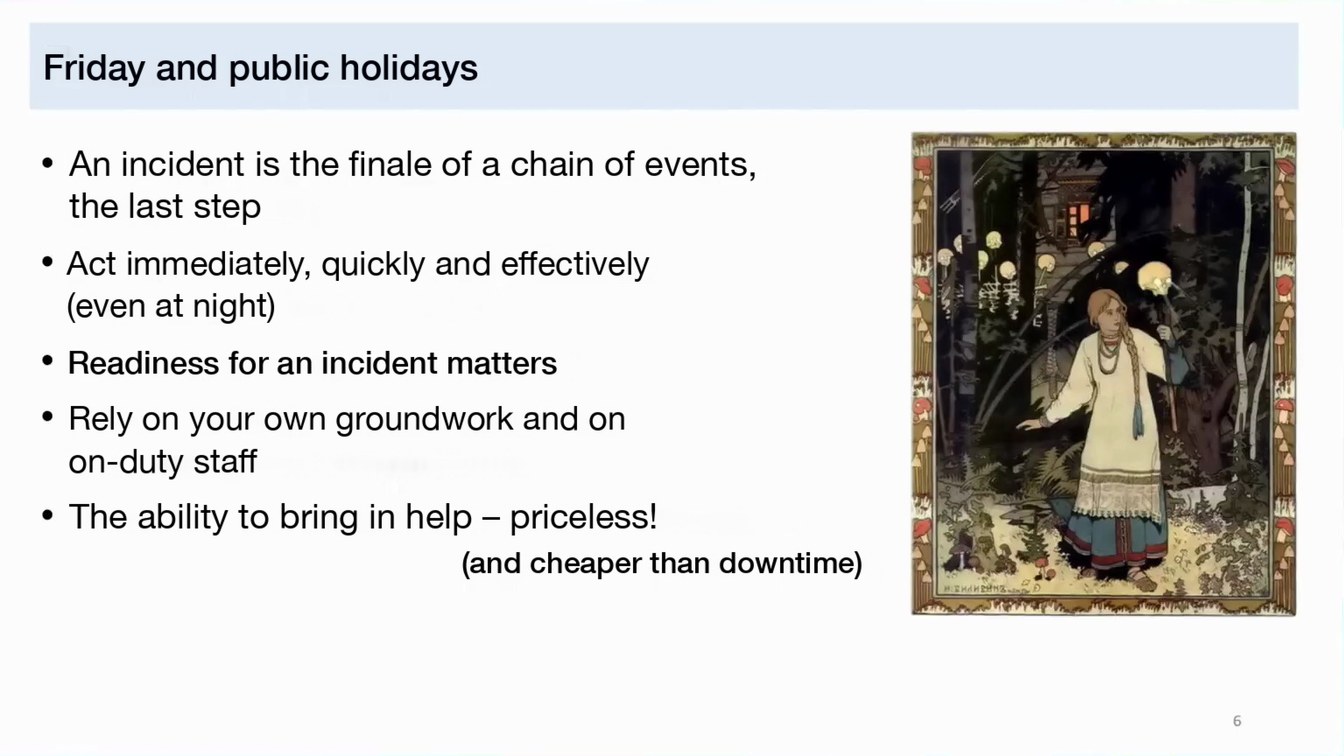
Friday and public holidays
An incident is the finale of a chain of events, the last step Act immediately, quickly and effectively (even at night)
Readiness for an incident matters
Rely on your own groundwork and on on-duty staff
The ability to bring in help – priceless!
(and cheaper than downtime)
Page 807:05:23 Slide text
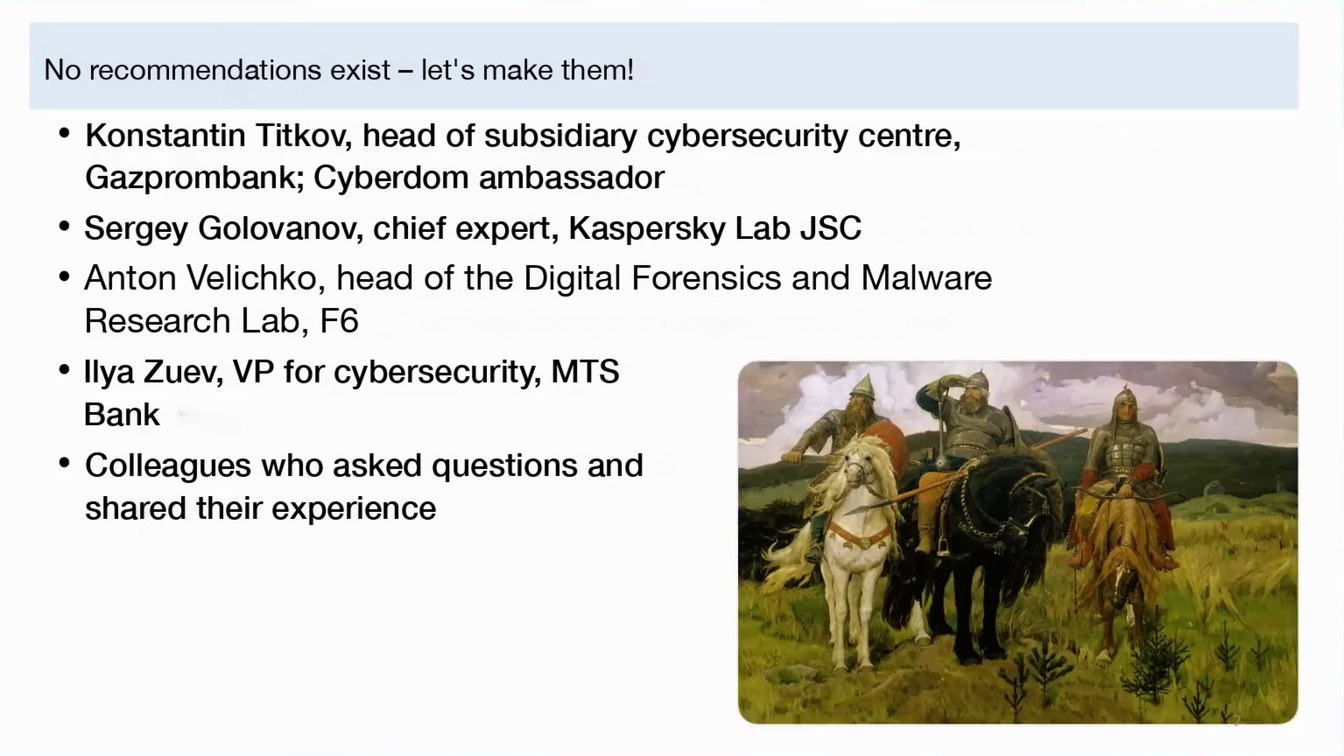
No recommendations exist – let's make them!
Konstantin Titkov, head of subsidiary cybersecurity centre, Gazprombank; Cyberdom ambassador
Sergey Golovanov, chief expert, Kaspersky Lab JSC
Anton Velichko, head of the Digital Forensics and Malware Research Lab, F6 Ilya Zuev, VP for cybersecurity, MTS Bank Colleagues who asked questions and shared their experience
Page 907:06:02 Slide text
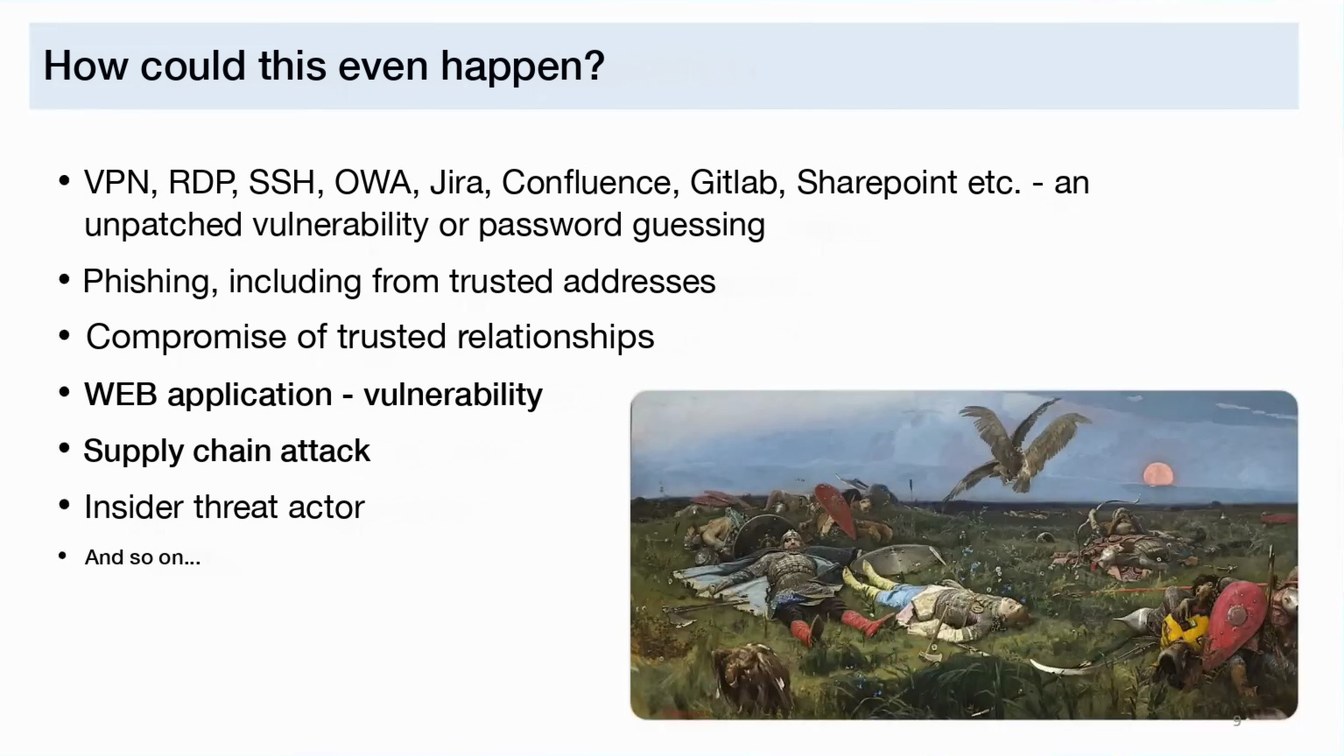
How could this even happen?
VPN, RDP, SSH, OWA, Jira, Confluence, Gitlab, Sharepoint etc. - an unpatched vulnerability or password guessing
Phishing, including from trusted addresses Compromise of trusted relationships
WEB application - vulnerability Supply chain attack
Insider threat actor
And so on...
Page 1007:06:42 Slide text
Should you pay the ransom?
Page 1107:07:53 Slide text
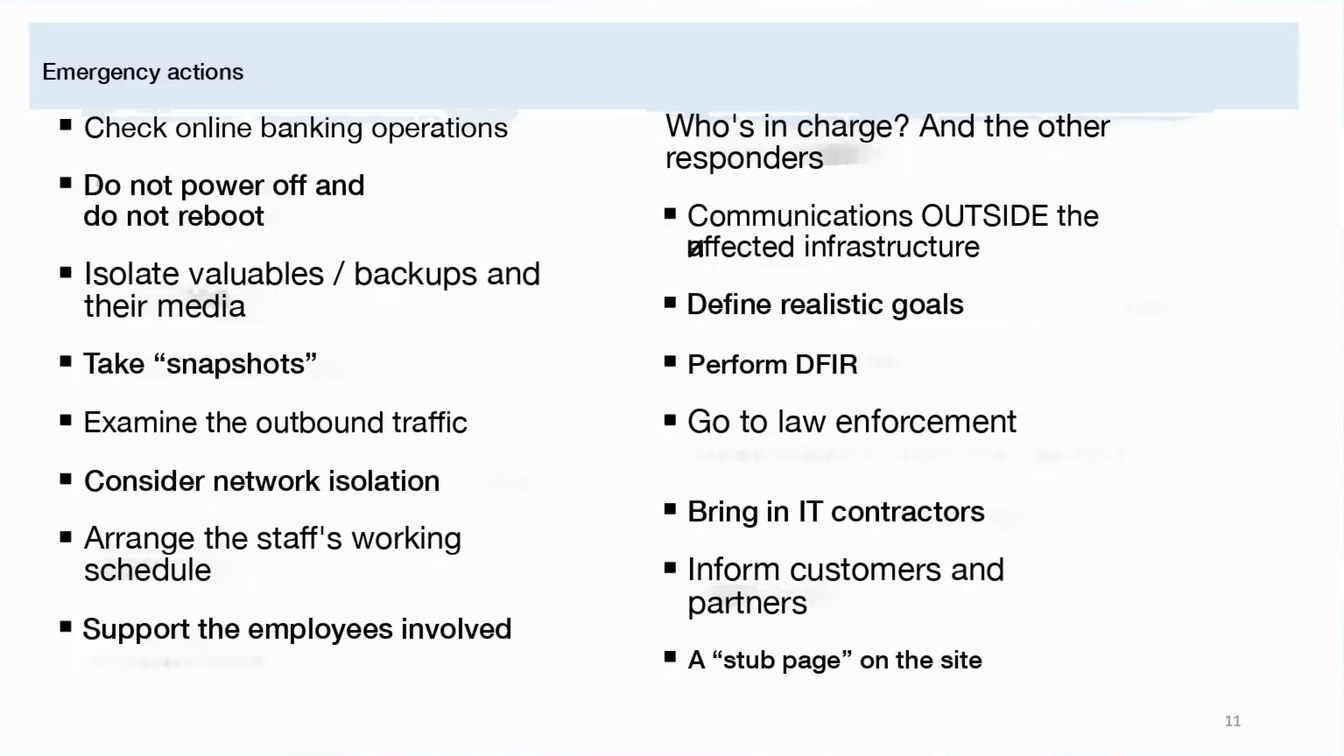
Emergency actions
Check online banking operations
Do not power off and do not reboot Isolate valuables / backups and their media
Who's in charge? And the other responders Communications OUTSIDE the affected infrastructure
Define realistic goals
Take “snapshots”
Perform DFIR
Examine the outbound traffic
Consider network isolation
Arrange the staff's working schedule Support the employees involved
Go to law enforcement
Bring in IT contractors
Inform customers and partners
A “stub page” on the site
11
Page 1207:08:34 Slide text
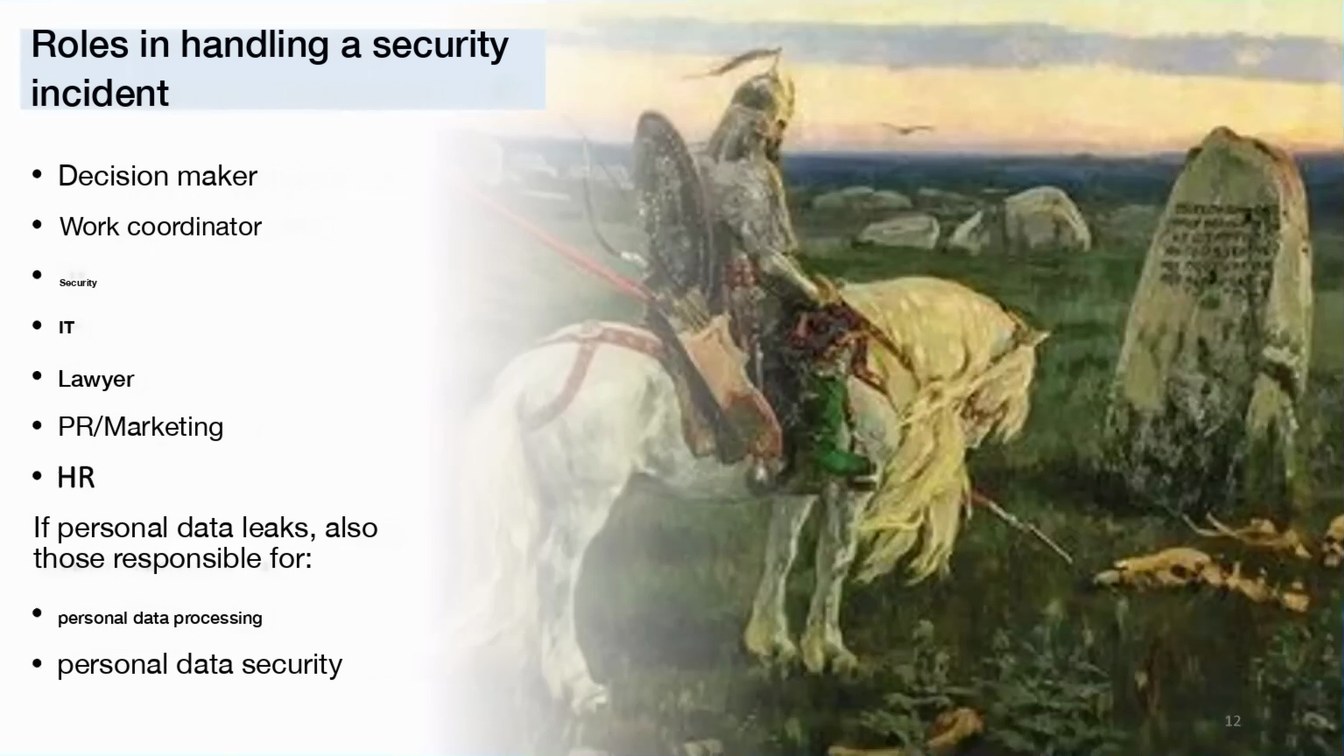
Roles in handling a security incident
Decision maker
Work coordinator
Security
IT
Lawyer
PR/Marketing
• HR
If personal data leaks, also those responsible for:
personal data processing
personal data security
12
Page 1307:09:16 Slide text
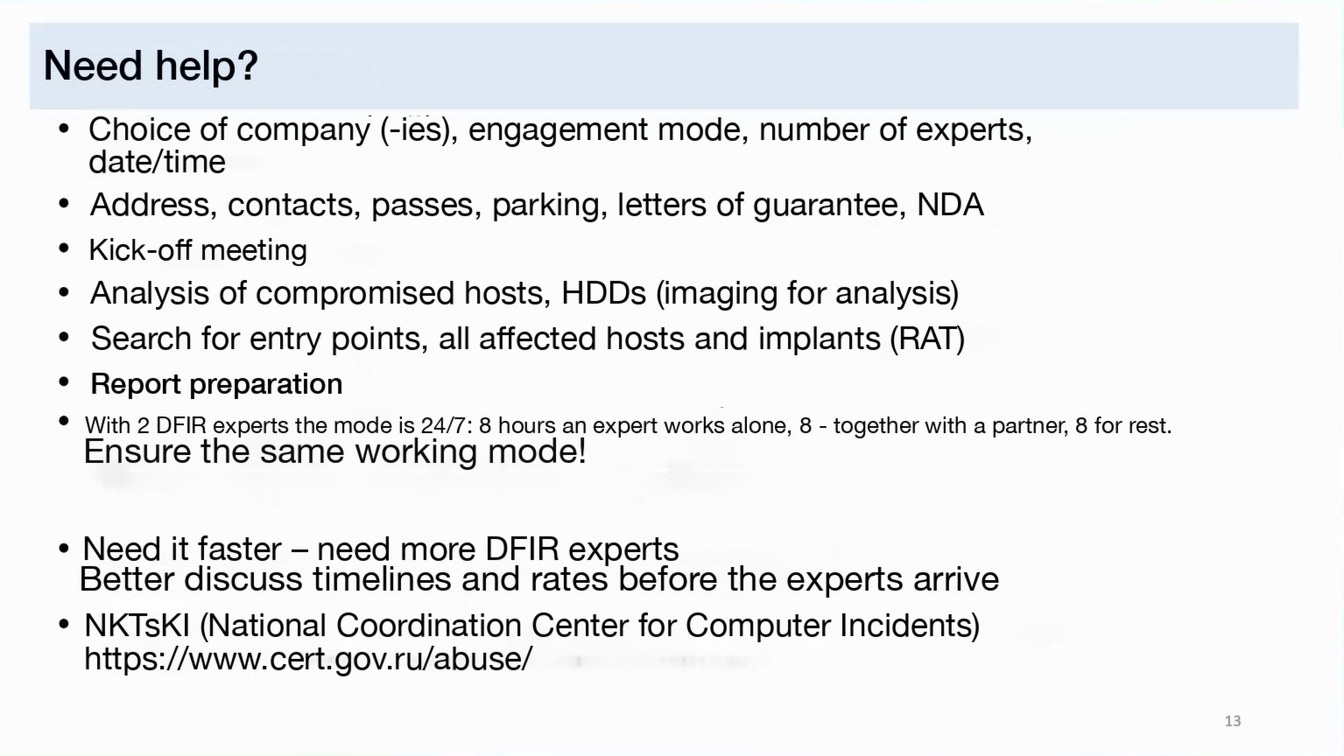
Need help?
Choice of company (-ies), engagement mode, number of experts, date/time
Address, contacts, passes, parking, letters of guarantee, NDA Kick-off meeting Analysis of compromised hosts, HDDs (imaging for analysis) Search for entry points, all affected hosts and implants (RAT) Report preparation
With 2 DFIR experts the mode is 24/7: 8 hours an expert works alone, 8 - together with a partner, 8 for rest.
Ensure the same working mode!
Need it faster – need more DFIR experts Better discuss timelines and rates before the experts arrive
NKTsKI (National Coordination Center for Computer Incidents) https://www.cert.gov.ru/abuse/
13
Page 1407:10:12 Slide text
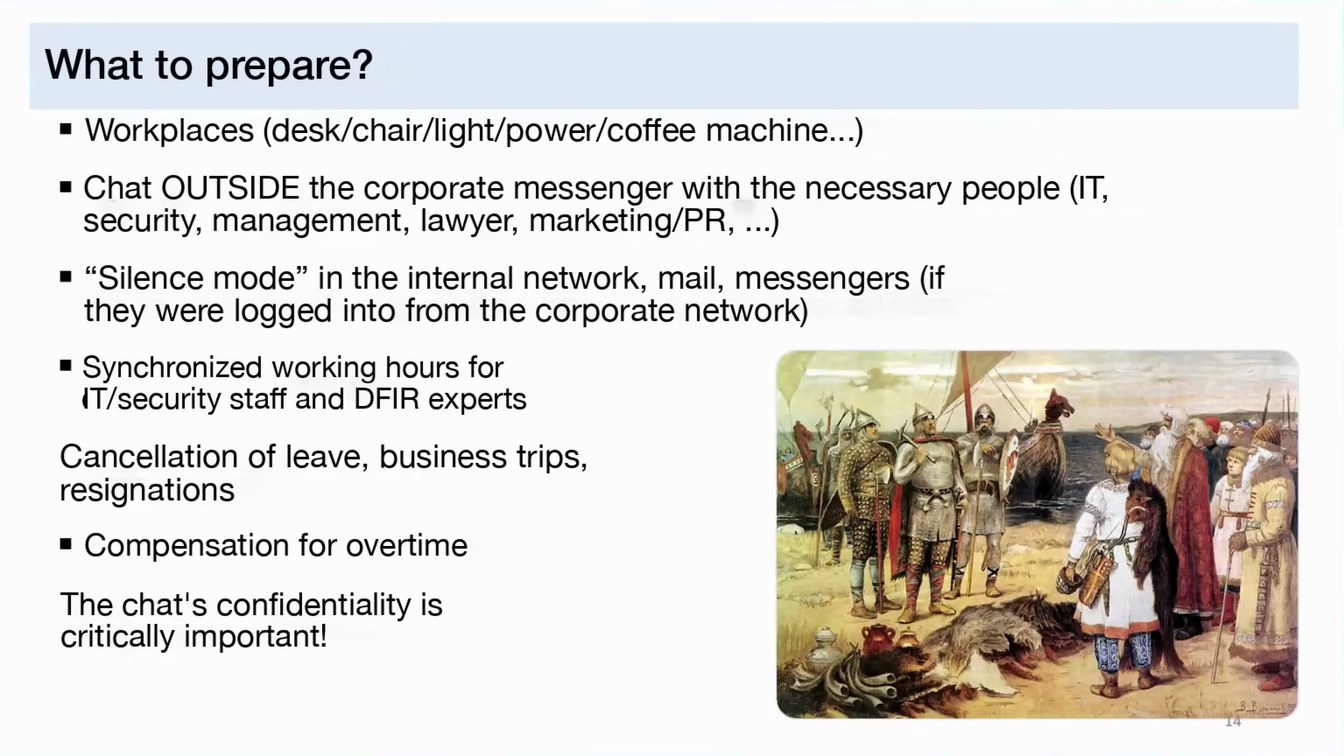
What to prepare?
Workplaces (desk/chair/light/power/coffee machine...)
Chat OUTSIDE the corporate messenger with the necessary people (IT, security, management, lawyer, marketing/PR, ...) “Silence mode” in the internal network, mail, messengers (if they were logged into from the corporate network) Synchronized working hours for IT/security staff and DFIR experts Cancellation of leave, business trips, resignations
Compensation for overtime
The chat's confidentiality is critically important!
Page 1507:11:15 Slide text
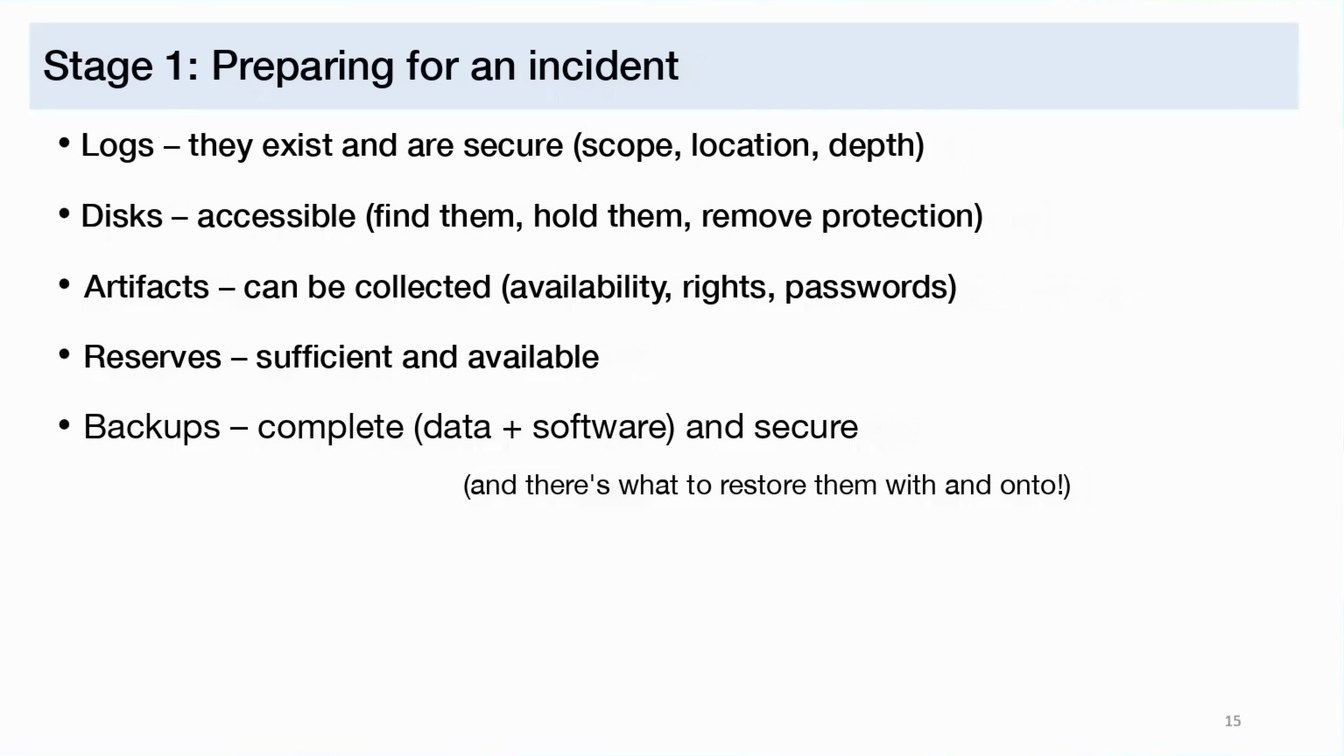
Stage 1: Preparing for an incident
Logs – they exist and are secure (scope, location, depth)
Disks – accessible (find them, hold them, remove protection)
Artifacts – can be collected (availability, rights, passwords)
Reserves – sufficient and available
Backups – complete (data + software) and secure
(and there's what to restore them with and onto!)
15
Page 1607:12:25 Slide text
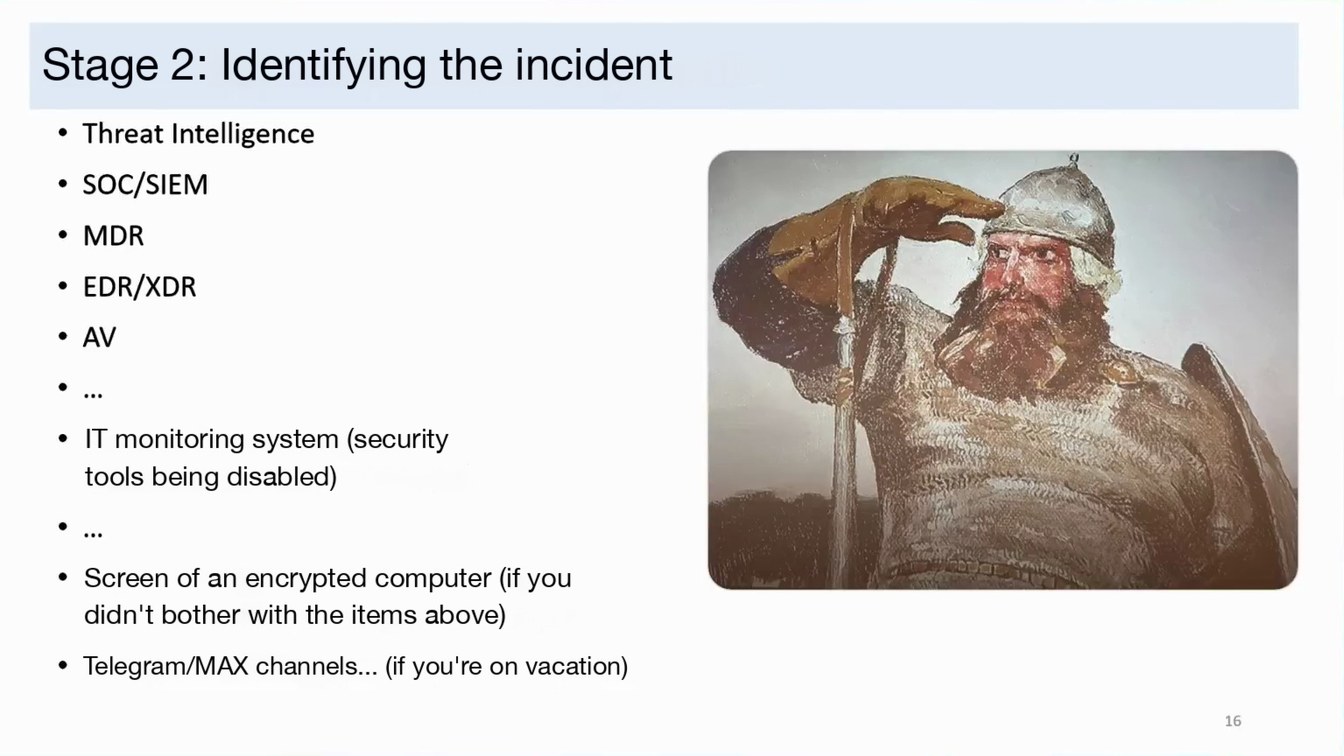
Stage 2: Identifying the incident
• Threat Intelligence
• SOC/SIEM
• MDR
• EDR/XDR
• AV
IT monitoring system (security tools being disabled)
Screen of an encrypted computer (if you didn't bother with the items above)
Telegram/MAX channels... (if you're on vacation)
16
Page 1707:13:21 Slide text
Stage 3: Containment
Do NOT cut the power! Do NOT reboot!
BUT disconnect from the LAN:
Virtual machines
Physical machines
Wi-Fi and other interfaces
17
Page 1807:14:03 Slide text
Stage 4. Cleanup
Removing trojans/implants/web shells/RAT etc. Installing security updates (for entry points + the latest)
Restoring security tools Changing passwords:
domain and system accounts. Kerberos – x2 and local ones, in DBMS, VPN, applications... and SSH/SSL keys too.
and web service certificates. and passwords/keys in your online banking.
and in internet services and personal accounts. Change ALL passwords, basically!
Check the list of accounts. Including system ones.
18
Page 1907:14:59 Slide text
Stages 5-6: Recovery and lessons learned
Restoring from backups
Turning interfaces back on
Report on the incident and the response
Recommendations to NOT repeat it
Work plan
19
Page 2007:15:44 Slide text
Does all this take long?
Rough timeline estimates:
Ransomware not launched yet? From 2 hours.
Analysis of a couple of HDDs – 1 day
100 - 200 hosts - 1 week of work for 1 expert 1000 - 2000 hosts - 2 weeks for 2 experts 50,000 - 150,000 hosts - 2 months of work by combined teams
Maybe online?
20
Page 2107:16:11 Slide text
01010106
10101 B1810I
102900
1 0801
i010| 000[0| 0101019
IO TOTO LOT0001
ПО 101
01
110 101 011 010 110 101 011
010110 *10110 101
110 101 011 10 101 011
) 101
101 011 01
101 01
01 011 010
107
111 010110
101
5.
Online is possible
Online is possible if you can collect logs, evidence etc. The experts will study the data and request what's missing
Online IR can be cheaper in terms of expert rates no travel and business trip costs!
BUT: without coordinated, fast and expert work on the client's side DFIR can take longer and even cost more than offline!
21
Page 2207:16:46 Slide text
Is that all? No, unfortunately...
Going to law enforcement
Complaint materials
DFIR report
KUSP
Seizure
Opening a criminal case
Certificate recognizing the company as victim
Dealing with other government bodies
22
Page 2307:17:35 Slide text
And that's still not all
Theft of information and personal data:
ransom for deleting it
selling the data
publishing the data
Personal data of employees and customers
Intellectual property
Contract terms
Keys and passwords
23
Page 2407:18:38 Slide text
In case of a personal data leak
Enquiries from customers, partners, law enforcement.
In the future - new parts of data previously stolen from you may be published and passed off as a new leak.
You must be ready to analyze such data in order to either confirm that it's an old leak, or run DFIR again or a Compromise Assessment (CA).
24
Page 2507:19:20 Slide text
In case of a personal data leak
So now (and in the future - every time):
24 hours - notify Roskomnadzor
72 hours - report on the results of the internal investigation CII entity - notify NKTsKI within 24 hours (GosSOPKA format)
Under the Central Bank - ASOI FinCERT
• GDPR (?)
25
Page 2607:19:41 Slide text
In advance, for each party to be informed
notification procedure and requirements for data form and content
primary and backup notification channels
access to personal accounts
account for the branch network of your organization / group / holding
those responsible for drafting, approving and sending reports
procedure for informing data subjects about the leak and for posting leak information in open sources those responsible for drafting, approving and publishing the information
agree press release templates in advance
26
Page 2707:20:02 Slide text
Recommendations for reporting on leak response
The report may consist of the following sections:
Introduction - the date and time the leak information appeared, the composition of the information claimed and the information actually published by the attackers
Investigation results - circumstances and causes of the leak, composition and volume of the leaked data or of data that could have leaked, whether data subjects' interests may suffer from the leak as projected onto the organization's services, whether the culprits were identified and what measures were taken against them
Conclusion from the analysis of the leaked data – assessment of its authenticity/fakeness and uniqueness given third-party leaks
Measures taken - tactical and strategic measures with a detailed description
Better to prepare an exhaustive report!
Page 2807:20:44 Slide text
Got it. Can I have a preventive check-up?
дао дерать ели и тас есть, но того еще не при т лифраструктуру взломали и могут
What to do if you suspect that your IT infrastructure has been hacked and may be encrypted/destroyed, but this hasn't happened yet.
What could be such grounds?
A sense that the IT infrastructure is working incorrectly, for example because of changes made in it with administrative rights that you did not authorize Vulnerable software or services on the external (internet) perimeter that you don't fix promptly.
A penetration test report with a successful compromise of the infrastructure. And much more...
In this situation it makes sense to: run a CA (Comromise Assessment) – searching for traces of a breach
check the security, integrity and availability of your backups (data backup copies)
Prepare for a future incident
28
Page 2907:22:08 Slide text
How to prepare? CISO & CIO/CTO Develop a response plan for a successful cyberattack with the most dismal consequences
Create a reserve of equipment, funds etc.
Pay special attention to the security of data backups and of the software itself (“3-2-1”)
Protect the backup system Response exercises
measure the time Choose DFIR partners in advance If you suspect a breach
- Comromise Assessment
29
Page 3007:23:32 Slide text
How to prepare? CEO
Pass recommendations to IT and security
Check that everyone can do everything and everyone has everything, the preparatory steps are done
Estimate the downtime during a security incident
In an incident, bring in all resources
Support the employees while the incident's consequences are being dealt with, not punish them
JO
A demotivated employee has no interest in incident response, while an employee who let it happen (their fault or not) but fixed the situation is better and more valuable for your company than a new one!
30
Page 3107:24:12 Slide text
CEO quick guide:
Recommendations:
https://cyberdom.pro/recomendationbig
https://cyberdom.pro/recomendationceo
Thank you for your attention!
Konstantin Titkov
31